
انطباق با تأثیرات تغییرات آب و هوایی مستلزم یک قرارداد اجتماعی منسجم است که در آن بازیگران مختلف بر روی توزیع روشن نقشها و مسئولیتها توافق دارند. یک نیاز فوری، درک قراردادهای اجتماعی تصور شده در مورد نقش ها و مسئولیت های مورد انتظار است، که به ویژه در شهرهایی که گروه های اجتماعی بسیار متنوع دور هم جمع می شوند، مرتبط است. با این حال، شواهد تجربی محدودی در مورد این انتظارات وجود دارد، زیرا اغلب به طور ضمنی و به سختی می توان آنها را در میان جمعیت های بزرگ و گروه های ناهمگن به دست آورد. در اینجا ما قرارداد اجتماعی در مورد مدیریت خطر سیل در بمبئی را با استفاده از مفهوم گوش دادن اجتماعی در ترکیب با دادههای توییتر ارزیابی میکنیم. ما شکاف های گسترده ای را بین و درون قراردادهای اجتماعی تصور شده می یابیم. احساساتی مانند ناامیدی و بیتفاوتی که در توییتها بیان میشود، این شکافها را توضیح میدهد و نیاز به ایجاد اعتماد برای دستیابی به قراردادهای اجتماعی پذیرفته شده و مؤثر برای سازگاری را برجسته میکند. دروس نظری، تجربی و روش شناسی را می توان به شهرهای دیگر و فراتر از آن منتقل کرد.
معرفی
تأثیرات مورد انتظار از تغییرات آب و هوایی به قدری فراگیر خواهد بود که مستلزم تشدید تلاشهای سازگاری بهطور قابلتوجهی است، از بسیاری جهات مستلزم دگرگونیهای اساسی در نحوه مدیریت جوامع با خطرات خود است . شهرها، بهویژه، با چالشهای سازگاری بالایی مواجه هستند، زیرا اغلب در خط مقدم قرار گرفتن در معرض خطرات اقلیمی 8 قرار دارند ، در حالی که با وابستگی زیاد به مسیر مشخص میشوند، و سازگاری دگرگونکننده را دشوار و از نظر اجتماعی مورد مناقشه قرار میدهند .. بنابراین، رویارویی با چالشهای انطباق شدید مستلزم تلاشهای جمعی از سوی بازیگران مختلف جامعه (دولت، شهروندان، جامعه مدنی، بخش خصوصی و غیره) است، به طور ایدهآل با درک مشترک در مورد اهداف سازگاری مشترک و توزیع روشن وظایف و مسئولیتها 9 ، 10 ، 11 , 12 , 13 . با این حال، در واقعیت، صورت فلکی چند بازیگر اغلب با دیدگاههای متضاد در مورد انتظارات بازیگران از بازیگران دیگر یا نقشها و مسئولیتهایی که گروههای بازیگر به گروههای بازیگر دیگر نسبت میدهند، مشخص میشوند. شکاف ها و ابهامات مرتبط به عنوان مانع مهم در حاکمیت سازگاری شناسایی شده است 14. بنابراین مهم است که اولاً دیدگاههای اغلب ضمنی یا ضمنی بازیگران مختلف به تنهایی و همچنین نقشها و مسئولیتهای دیگران در رابطه با سازگاری با تغییرات اقلیمی را آشکار کرده و آشکار کنیم، ثانیاً ارزیابی کنیم که چگونه بازیگران در شهرها و سایر زمینههای اجتماعی در مورد دیدگاههای بالقوه متفاوت مذاکره کنید و سوم، بررسی کنید که آیا و چگونه آنها در ترتیبی که به تعدیل شکافهای غیرقابل حل در انتظارات کمک میکند و در حالت ایدهآل به یک دیدگاه مشترک در مورد نحوه توزیع مسئولیتهای سازگاری کمک میکند یا خیر، میرسند 15 ، 16 ، 17 ، 18 ، 19 ، 20 ، 21. با این حال، این درک عمدتاً تا به امروز وجود ندارد، به ویژه در محیطهای شهری که گروههای اجتماعی متنوع و جهانبینیهای آنها با هم برخورد میکنند.
ادبیات قبلی کمک های مهمی برای ارزیابی چگونگی مذاکره با اهداف انطباق و همچنین نقش ها و مسئولیت های سازگاری داشته است – که هسته اصلی حاکمیت سازگاری را تشکیل می دهد 22 . مفهوم “قراردادهای اجتماعی” در این زمینه در ادبیات پیشنهاد شده است، با این استدلال که چنین عدسی می تواند تحقیقات آینده را برای توضیح سیاست های پیچیده انطباق راهنمایی کند . با این حال ، تنها تعداد محدودی از مطالعات در مورد سازگاری و زمینههای مرتبط با پایداری، تابآوری یا مدیریت ریسک بلایا از اصطلاح قرارداد اجتماعی استفاده کردهاند .و اگر چنین است، عمدتاً به روشی آزاد و نسبتاً نامشخص یا کمی مفهومسازی شده است. بیشتر ادبیات با موضوعات پیرامون نقش ها و مسئولیت اقتباس بدون اشاره صریح به مفهوم قراردادهای اجتماعی 10 ، 14 ، 15 ، 16 ، 18 درگیر است . همچنین آخرین گزارش ارزیابی IPCC، که بر اساس ادبیات موجود است، به صراحت قراردادهای اجتماعی را برای انطباق ارزیابی نمی کند 22 . این نشان میدهد که این مفهوم تاکنون جذابیت چندانی نداشته است، علیرغم دستاوردهای احتمالی که برای تولید دانش و پشتیبانی تصمیمگیری خواهد داشت. مطالعه ما به درخواست برای استفاده از قراردادهای اجتماعی به عنوان یک لنز تحلیلی قویتر پاسخ میدهدو رویکردی برای ارزیابی تجربی قراردادهای اجتماعی برای انطباق ایجاد کنید.
با تکیه بر ادبیات اهداف انطباق، حاکمیت ریسک و مسئولیت انطباق 9 ، 10 ، 11 ، 12 ، 13 ، ما یک قرارداد اجتماعی برای سازگاری با تغییرات اقلیمی را به عنوان یک ترتیب جمعی بین بازیگران مختلف یک جامعه بر روی چشم انداز و اهداف کلی تعریف می کنیم. به عنوان توزیع متقابل نقش ها و مسئولیت ها برای دستیابی به آن اهداف. به عبارت دیگر، یک قرارداد اجتماعی آرایش جمعی از آنچه یک جامعه می خواهد و چگونه به آنجا می رسد را توصیف می کند. ما قراردادهای اجتماعی را دو نوع میدانیم (شکل 1). Type 1 describes a social contract which exists where actors’ visions and perceptions on mutual roles and responsibilities do not align but where actors seek a social contract to precisely mediate these differences. Type 2 describes a social contract in a situation in which actors’ visions and perceptions on mutual roles and responsibilities align and actors seek a social contract to explicate and formalize this agreement.
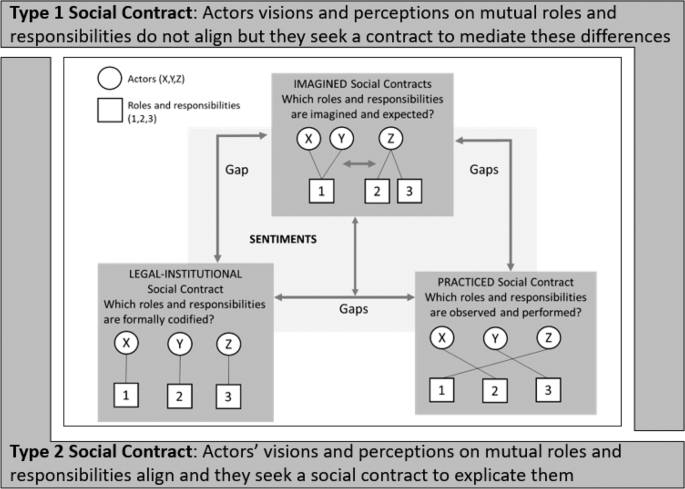
Conceptual framework showing the types, dimensions, and gaps in social contracts.
Within each of these types (1 and 2), social contracts for adaptation can have three dimensions—imagined (ISC), practiced (PSC) and legal-institutional (LSC) (see Supplementary Table 1 for a detailed description)23. The ISC describes actors’ envisioned goals and viewpoints on the distribution of roles and responsibilities. The PSC describes the ‘real-life’ goals and observable (de facto) distribution of roles and responsibilities for adaptation between actors. The LSC describes the formally defined goals and visions and legally encoded (de jure) distribution of roles and responsibilities for adaptation between actors.
Our center stage for the empirical analysis of this paper is on understanding the imagined social contracts (see Supplementary Table 2 for detailed overview) and their relations to the practiced and legal social contracts. The imagined social contracts do not only result from the practiced and legal dimensions but also influence them. Hence, on the way towards encoding and practicing new social contracts, the most immediate need is a better understanding of the potentially diverging ways in which different actors envision new roles and responsibilities for other actors and themselves, i.e. which ISCs they have and wish for.
There may be gaps and contestations between the three dimensions of social contracts—for eg. rifts between the de facto, observable distribution of roles and responsibilities (practiced) and the de jure stipulations on formally defined roles and responsibilities (legal). Gaps could also exist within one dimension, e.g., when different actors have different imagined social contracts in mind regarding the distribution of roles and responsibilities. While it might not be possible to fully resolve these gaps and contestations, we suggest that engaging with these differences to at least identify them and become aware of them would allow actors to form a type 1 social contract to mediate the differences and deal with the gaps (which might still remain). Laying open these gaps and finding a way to deal with them would then ideally inform the process of actors aligning the gaps and potentially closing them with the objective of shaping a type 2 social contract.
Against this background, this paper aims to contribute to empirical knowledge on actors’ perceived roles and responsibilities, the potential gaps and contestations between them and the ways in which they are currently being negotiated. By doing so, the paper aims to inform the discussion and formation of at least type 1 and ideally type 2 social contracts on climate change adaptation in cities and beyond.
The need for explicit social contracts for adaptation is most starkly illustrated in cities, proving a valuable and apt unit of analysis. Different viewpoints on adaptation goals and priorities often clash in cities, as it is there that very heterogeneous social groups – characterized by socio-cultural diversity, competing economic and political priorities, asymmetric power relations, different levels of risk tolerance and adaptive capacities—are coming together27. These gaps and contestations may arise in view of addressing pertinent questions on political feasibility, power dynamics and trade-offs involved, such as whose priorities get embedded in adaptation pathways, who decides whose futures are protected and how costs are distributed, which spatio-temporal trade-offs will need to be made etc28.
We use the case study of flood risk management in the coastal megacity of Mumbai to assess the negotiation of social contracts for adaptation. Mumbai is the seventh largest metropolitan city globally and ranks among the top 10 coastal megacities at risk to coastal flooding and climate change impacts29,30 and hence is characterized by some of the highest adaptation pressure one can find31,32,33,34,35. While the city witnessed its most catastrophic flood event in 2005, when one-third of its annual rainfall fell in 24 hours resulting in the death of 1493 people and estimated losses of USD 1.7 billion36,37, heavy rainfall and flooding are almost an annual phenomenon during the monsoon season.
The current social contract for flood risk management in Mumbai is contested and riven between the practiced and legal social contract. Mumbai is confronted with stark inequality—being home to a powerful urban elite while 42% of the city’s population lives in informal settlements. The latter are at high-risk to flooding. Informal settlers are often being forced to live in environmentally risk prone areas, are socially excluded from civic services and poorer38, yet are often seen as illegal encroachments39. According to core national legislation40, disaster management responsibilities are entrusted to the state. Previous studies point out two major shortcomings in the legislation: one, the silence of the Act on state responsibility towards those impacted by disasters41 and two, the de facto implication of the Act on ‘active and willing support and cooperation of the local community’ in disaster management42. While the local municipal authority is entrusted with emergency response function, the national guidelines on urban flood management (UFM) foresee the role of citizens as first responders, even before state machinery steps in43.
The UFM guidelines recognize that the role of civil society has shifted from being “mere relief organizations to focusing on rehabilitation, reconstruction and mitigation” (p.101). Civil society is further explicitly expected to play a role in reducing socio-economic vulnerability of the poor43. Previous studies have emphasized the de facto role of civil society organizations in coping with flooding in Mumbai44,45. However, against the context of India’s economic liberalization which led to increased social and economic marginalization in major Indian cities, including Mumbai, it is important to note the dominant discourse on ‘civil society’ by urban elites which supports exclusionary restructuring policies against the poor39. A recent example of elite capture is seen in the contestations around the highly controversial Coastal Road infrastructure project which is perceived to serve the elite and has prevailed despite protests against it due to its adverse impacts on the sensitive coastline, livelihoods of fishing communities and being labeled maladaptive46.
Hence, there is an urgent need to capture the imagined, diverging viewpoints of different actors against this contested background. Furthermore, despite the freedom of speech being a constitutional right in India47, declining press freedom has been a concern raised in national and international media citing corporatisation in ownership, political control, safety of journalists and absence of civil society demands as the main reasons48,49. Therefore, in this analysis we explore social listening on Twitter, as it forms an increasingly important marketplace to capture different opinions and voices. However, in the context of debates on flood risk in Mumbai, elite actors potentially play a significant role due to favorable factors such as digital access and literacy.
In the age of digitalization and big data, social media, in terms of its volume, scale and speed offers many opportunities for urban sustainability research as well as urban planning and decision-making50. A wide range of quantitative (descriptive statistics such as correlation, regression, cluster analysis etc.) and qualitative (content analysis, social network analysis, thematic analysis etc.) research methods can be applied to different types of big data including Twitter51,52,53,54. Examples of studies using geotagged Twitter data, or sentiment analyses in urban, sustainability and adaptation research is manifold51,55,56,57,58.
Social media offer an important arena to inductively capture and assess the exchange of opinions and negotiations of roles and responsibilities of different actors such as public sector, citizens, civil society and private sector, including nuanced sentiments such as frustrations, hopes etc. Adopting a grounded theory approach59, we combine the inductive exploration of data to capture the dominant debate on Twitter with a deductive application of a social contract theoretical lens. For this article, we developed and utilized the approach of social listening (also called social media analytics)60, defined as an “active process of attending to, observing, interpreting, and responding to a variety of stimuli through mediated, electronic, and social channels”61. از این رو، تجزیه و تحلیل تعادلی را در ترکیب پتانسیل دادههای بزرگ با بینشهای مربوط به زمینه ایجاد میکند تا «پیچیدگی متنی» را در تحقیقات انطباق به تصویر بکشد – همانطور که فورد و همکارانش آن را درخواست کردند. 62 . شکل 2 گردش کار ما را خلاصه می کند، شرح روش شناسی دقیق در بخش روش ها ارائه شده است.

فلوچارت مراحل انجام شده در جمع آوری و تجزیه و تحلیل داده های توییتر.
نتایج
صداهایی که خواستار مدیریت و سازگاری بهتر خطر سیل هستند
In terms of the overall Twitter user profile, our data shows that the vast majority of contributions to the flood-related debate in Mumbai comes from accounts held by private users / individuals (59%), most of which are likely to be residents of the city or otherwise closely connected to it, followed by accounts held by media organizations (25%), civil society groups, public sector organizations and politicians (e.g., civic authority, political parties, politicians such as ministers or mayors) and private sector (mainly private weather forecasting, insurance and aviation companies) (Fig. 3). The smaller number of tweets by actors such as civil society or public sector does not necessarily translate into a minor contribution to and influence over the debate, as many of these actors effectively serve as multipliers, e.g., in the case of political parties or civil society interest groups.

a Distribution of Twitter users by actors; b Distribution of tweets by source device and language.
The participants of the dominant Twitter debate are largely composed of educated and affluent urban middle classes and elites, when measured along the Tweet’s language and type of device (Fig. 3). In India, the ability to communicate in English is strongly correlated with having a higher education level and economic status63. 82% of the tweets were posted in English, which compares to only 10% of the Indian population who speaks English. Even though the percentage of English-speakers is probably significantly higher in Mumbai—detailed numbers are lacking–this divide clearly indicates a dominance of the elite in the debate.
The picture that better-off actors participate over-proportionally in the flood-related Twitter debate also holds when looking at the type of devices used for tweeting (Fig. 3). 27% of the tweets in our dataset were posted from Apple devices, which compares to an India-wide market share of just above 3 percent for these devices64 even though the market share is probably higher in the city of Mumbai. Also, 38% of tweets were posted from usually more affordable Android devices, which compares to a national market share of almost 96% for these devices (ibid). Even though these figures suggest that better-off and affluent citizens contribute to the Twitter debate over-proportionally, it is important to highlight that many Twitter users raised their voice for others. Our data hence shows that especially marginalized and highly vulnerable groups who are not directly participating in the debate on Twitter are still strongly represented e.g., by civil society organizations.
In terms of themes covered, our data shows that the Twitter debate covered a surprisingly wide range of topics, of which two-thirds of the tweets are in one or the other way relevant for the social contract analysis. Actors expressed their expectations of roles and responsibilities for flood risk management across a wide range of themes including transport-related concerns, complaints, impacts, demands etc. (Fig. 4b). One-third of the tweets mainly provided weather and waterlogging updates which provide relevant insights for flood hotspots mapping, early warning and emergency preparedness.

a Temporal distribution of dominant themes in the Twitter debate over monsoon 2021 (b) Mapping of dominant themes in the Twitter debate.
Roles and responsibilities ascribed to the public sector
Expectations towards the public sector and politicians, in particular the ruling party and state bureaucracy, were mainly raised by individuals and the public sector itself i.e. opposition parties. Not surprisingly, our findings show those voices would aspirationally expect the public sector, especially the drainage department of the city’s civic authority, to be responsible for flood risk management. However, at the same time, our data clearly shows that in terms of realistic expectations—i.e. what the public sector will do rather than what it should do–actors did not anticipate the public sector and politicians to play that role in flood risk management. The analysis of sentiments proved to be an important lens for unpacking and understanding these gaps in actors’ expectations in more detail.
First, we find an important gap between the imagined and legal-institutional social contracts which help us understand why individuals and opposition parties ideally expect that flood risk management should be a public sector responsibility. We identified two major sentiments—frustration and humiliation—that explained this gap. Out of frustration, individuals and opposition parties claim accountability for the allocation of taxpayers’ money (Table 1, #1). Some voices even suggested to not pay taxes to the civic authority until the “waterlogging problem is solved” (Table 1, #2). This claim is also made in view of the allegations of corruption in drainage cleaning (legally a core task of the public sector43,65), as reported by mainstream media in the past years66,67,68. In addition, individuals expressed their humiliation when calling for public sector actors to take their responsibility for flood risk management more seriously. Tweets expressed feelings of shame, arguing that the city is facing flooding every year despite being the financial and commercial capital of the country and having the largest civic budget (Table 1, #3). However, surprisingly, none of the tweets called for specific adaptation or flood risk management measures. Instead, tweets tended to be more generic and called on the public sector and politicians to find solutions to “fix” the flooding problem (Table 1, #4).
Second, we clearly find a gap between the imagined and practiced social contracts which help us understand why individuals and opposition parties did not expect the public sector and politicians to play a role in flood risk management in reality. We identified two major sentiments—the lack of hope but also sympathy—that explained this gap. Individuals expressed their lack of hope in two ways: First, individuals and opposition parties showed their disappointment and frustration when the public sector and politicians do not deliver on their promises made before the monsoon. Individuals and opposition parties argue that apathy and ignorance on the part of the public sector and politicians in power explain this pattern. Second, many actors have given up hope because of experiencing flooding year after year. Individuals in particular felt being taken advantage of for their ‘everything goes’ attitude and the infamous ‘Mumbai spirit’ (which is used to praise the resilience of Mumbaikars)69 as an excuse by the public sector for their incompetence and poor governance (Table 1, #5, #6). Surprisingly, we identified a mix of humor and sarcasm to be a crucial sentiment in expressing and dealing with these gaps. Diverging from this view were a limited number of tweets, however, which also expressed sympathy for the public sector due to the intensity of rainfall.
Third, and probably most importantly, tweets revealed major contestations and gaps in the way different actors or even members of the same actor group (e.g., individuals) perceive and envision the imagined roles and responsibilities (ISCs) of public sector actors. These contestations most clearly surfaced in relation to the – often very laden – viewpoints on how to deal with the most vulnerable who often live in informal housing in high-risk areas. This debate peaked after thunderstorms and heavy rainfall led to landslides and collapsed walls, causing deaths of more than 30 people in mid-July 202170, six weeks into the data collection (Fig. 4). In favor of the vulnerable, individuals, civil society, other political parties and politicians expressed sorrow and sympathy. Public sector actors responded to the incident by expressing condolences and announcing relief and compensation. Individuals and civil society expressed their anger and demanded (including a petition to the High Court) to relocate the most vulnerable to safer areas because they did not accept the status quo (Table 1, #7). Many individuals asked who was responsible for “this mess”, “these deaths”, “fallen houses, buried people, sunken cars” and “why was nothing done to evacuate people from low-lying areas”. In contrast, other individuals blamed the flood victims and demanded to remove them, arguing that they are illegal dwellers and taxpayers’ money should not be used for their rehabilitation. Supporting arguments to this narrative believed that such settlements were being protected by politicians due to their important role as vote banks, in line with other studies38. The High Court dismissed the petition for basic survival support for the homeless coping with lockdown, saying “homeless must work, not expect everything for free” as also reported in the media71,72(جدول 1 ، شماره 8).
نقش ها و مسئولیت هایی که به افراد نسبت داده می شود
انتظارات از افراد در درجه اول از خود افراد و تا حدودی از بخش دولتی بود. دو دیدگاه متفاوت قابل شناسایی است. از یک سو، افراد مسئولیت افراد را زیر سوال بردند و به ویژه از طبقات متوسط و “کاست ها و طبقات مسلط” خواستند در صورت عدم رضایت از عملکرد رهبری فعلی در مدیریت سیل، در سیاست شرکت کنند و از حق رای خود استفاده کنند. جدول 1، شماره 9). برخی افراد دیگر شهروندان بمبئی را به دلیل جهل و بی علاقگی خود تحت پوشش “روح بمبئی” سرزنش می کنند و هموطنان خود را به دلیل “25 سال تماشای این روند” تحقیر می کنند که باید از آن خجالت بکشند. به طور مشابه، برخی افراد بیشکیبایی و عدم خشم خود را با توجه به تاثیرات سیل و حتی تلفات زیاد زیر سوال بردند (جدول 1 ).، شماره 10، شماره 11). آنها این را به عنوان تسلیم شدن در برابر فساد ادعایی توسط بخش عمومی درک کردند و استدلال کردند که فساد یکی از مقصران اصلی پاکسازی ناکارآمد زهکشی است. در مجموع، بسیاری از افراد، هموطنان خود را به نداشتن عاملیت در مبارزه با مشکل سیل سرزنش کردند. با این حال، دیگران اظهار داشتند که در زمانهای «پیامدهای بد» مانند «باران بمبئی»، این «مردم اطراف شما» هستند که «برای کمک میآیند، نه سیاستمدارانی که هر روز برای آنها در شبکههای اجتماعی میجنگید». قبلاً در زمینه خودیاری فعال بودند و دیگران باید در این زمینه فعال تر شوند.
از سوی دیگر، افراد دیگری نیز از هموطنان بمبئیکا خواستند که از سیل در بمبئی شکایت نکنند. به عنوان مثال، پوشش رسانه ای سیل در ایالات متحده و اروپا همزمان با سیل در بمبئی 73 ، 74 ، 75، برخی افراد را برانگیخت تا استدلال کنند که بمبئیکارها نباید شکایت کنند، اگر حتی جهان توسعه یافته می تواند تحت تأثیر سیل به این شکل شدید باشد. . برخی افراد با همدلی با بخش دولتی معتقد بودند که مردم نباید به دلیل شدت بارندگی نسبت به بخش دولتی خیلی انتقاد کنند. حتی یک دیدگاه از همه افرادی که با “# Mumbai Rains” مشکل دارند خواسته است که “شهر را ترک کنند” (جدول 1 ، شماره 12).
ما تنها یک انتظار عمده را از یک سیاستمدار نسبت به افراد شناسایی کردیم، که از “ثروتمندان و نخبگان” خواستیم تا به جلو قدم بردارند و در اقدامات امدادی و حمایتی پس از سیل در بمبئی و بخشهایی از ماهاراشترا 76 مشارکت کنند . سایر احزاب سیاسی از افراد انتظار داشتند که مراقب باشند “چه کسی واقعاً به آنها اهمیت می دهد، چه کسی می تواند مشکلات آنها را حل کند”.
نقش و مسئولیت های نسبت داده شده به رسانه ها
افراد عمدتاً از رسانهها ابراز ناامیدی کردند و خواستار توقف داستانهای «عذاب و تاریکی» درباره بمبئی شدند، بهویژه با توجه به سیلهایی که ایالات متحده و اروپا را نیز تحت تأثیر قرار داده است. آنها همچنین رسانههای بینالمللی را در مقایسه با «سیلهای بمبئی» که «خبر بینالمللی نمیسازد، اما هنوز زندگیها را ویران میکند» نسبت به پوشش اثرات سیلهای ایالات متحده و اروپا تعصب دارند (جدول 1، #13 ) . این باعث شد که افراد بر این باور باشند که “برخی از زندگی ها ارزشمندتر هستند” و این سوال را مطرح کردند که “چرا بسیاری از مردم در ایالات متحده و اروپا به بقیه جهان اهمیت نمی دهند”.
شکاف هایی که مانع یک قرارداد اجتماعی جدید برای کاهش خطر سیل می شود
به طور کلی، نتایج ما نشان میدهد که شکافهایی در قرارداد اجتماعی در مورد مدیریت خطر سیل در بمبئی در دو سطح وجود دارد: اول، بین قراردادهای اجتماعی مختلف مانند قراردادهای عملی و تصوری یا قانونی – نهادی و تصوری و دوم، بین تصورات اجتماعی مختلف. قراردادها در مورد اول، ما شکاف بزرگی بین سطح انتظارات آرمانی (آنچه بازیگران باید انجام دهند یا می خواهند انجام دهند) و واقع بینانه (آنچه معتقد بودند بازیگران واقعاً انجام خواهند داد) را نسبت به بخش عمومی پیدا کردیم. در مورد دوم، ما به طور شگفتانگیزی در مورد نقشها و مسئولیتها در قبال فقیرترین و آسیبپذیرترین جمعیتهای ساکن در سکونتگاههای غیررسمی و شدیداً سیلخیز، نزاعهای شدید پیدا کردیم. ما همچنین شکاف های مشابهی در انتظارات در همان گروه بازیگر از جنبه های دیگر یافتیم.
Hence, our results show that there are not only wide gaps between the current de facto flood risk practices, the legal de jure stipulations and the envisioned flood risk management, but also between the social contracts imagined for the future, even within allegedly joint actor groups. These gaps are troubling in view of the already grave and intensifying flood problem, the heavy financial and human-resource costs of adaptation and the urgency resulting from long lead times of adaptation policies and actions. The results suggest that laying open these gaps is a necessary first step towards closing them and building a future social contract which helps mediate these differences and maybe/ideally form a coherent joint perspective.
Discussion
We started our analysis by arguing that adapting cities to the inevitable impacts of climate change will require a strong and ideally coherent social contract in which different actors share an overall vision and agree on a clear distribution of roles and responsibilities for achieving that vision, despite potential differences in their respective individual perspectives. Our findings highlight the importance of improving our hitherto very patchy theoretical and empirical understanding of imagined social contracts in particular—and their relation to practiced and legal social contracts.
We found that there can be surprisingly large contestations and wide gaps regarding the roles and responsibilities which different actors envisioned for and ascribed to other actors. Our contribution is to lay open these gaps and disagreements in order to inform the discussion for actors to find an arrangement despite differences in viewpoints and arrive at a type 1 social contract. Ideally, we hope to even inform the process for actors to align the gaps and contestations—forming a type 2 social contract. Hence, through social listening, our findings show that becoming aware of these gaps between different expectations and decoding their drivers is the first step towards building new and coherent social contracts, so urgently needed for effective and equitable climate change adaptation across the globe77.
یک رویکرد گوش دادن اجتماعی به ما امکان میدهد تا نماهای ناخواسته و در نتیجه باز را در یک نمونه بزرگ N و تقریباً در زمان واقعی ضبط کنیم. توییتر یک بازار دیجیتال مهم فزاینده برای مذاکره و بیان نظرات بین بازیگران مختلف است و از این رو، یک پایگاه داده تجربی مهم برای تجزیه و تحلیل قراردادهای اجتماعی در حال تحول است. تجزیه و تحلیل صریح احساسات بیان شده در توییتر ابزار مفیدی بود که به ما در درک و توضیح دلایل ایجاد اختلاف در نقش ها و مسئولیت های درک شده بین بازیگران مختلف کمک کرد. ترکیب رویکردهای کلان داده با کدگذاری کیفی دستی به ما این امکان را میدهد تا احساسات ظریفتری مانند بیتفاوتی یا ناامیدی را در مقایسه با طبقهبندی احساسات بهعنوان مثبت، منفی و خنثی آموزشدیده از الگوریتم شناسایی کنیم. این امر به ویژه در جایی که انتظارات ضمنی هستند، یعنی جایی که بازیگران آنها را به طور واضح و مستقیم بیان نمی کنند، مفید بود. به طور کلی، احساسات شناساییشده نشاندهنده عدم اعتماد بین بازیگران مختلف است و ما پیشنهاد میکنیم که آنها ممکن است نقطه ورود مفیدی برای مطالعه شکلگیری قراردادهای اجتماعی در زمینهها یا کشورهای دیگر باشند.
علیرغم پتانسیل رو به رشد استفاده از داده های رسانه های اجتماعی، یک محدودیت عمده برای این تحلیل، بازنمایی جمعیت ها است. مشارکت در رسانههای اجتماعی ذاتاً با دسترسی به اینترنت مرتبط است و در مناطق جغرافیایی و جمعیتی متفاوت است – همچنین به عنوان «شکاف دیجیتال» شناخته میشود .. پلتفرمهای رسانههای اجتماعی از جمله توییتر اساساً اجازه میدهند تا بحثها را در سراسر شبکههای فرامحلی به تصویر بکشند، از این رو، ترکیب جمعیتی بازیگران در بحث توییتر در مقایسه با ترکیب جمعیتی جمعیت جغرافیایی بمبئی ذاتاً در تحلیل ما مشکلساز نیست. با این حال، در زمینه بحثهای توییتری در مورد سیل در بمبئی، ممکن است مهم باشد که در نظر داشته باشیم که نخبگان شهری در مقایسه با جمعیتهای غیررسمی و آسیبپذیر احتمال مشارکت بیشتری دارند (با توجه به پویاییهایی که در بالا مورد بحث قرار گرفت). با این وجود، سازمان های جامعه مدنی، رسانه ها، دانشگاهیان و غیره همچنان دغدغه های جمعیت آسیب پذیر را نشان می دهند.
در این مطالعه، هدف ما ارائه یک ارزیابی کامل از قراردادهای اجتماعی در بمبئی از طریق گوش دادن اجتماعی نیست، بلکه بخش مهمی از این بحث را که در فضای مجازی آینده توییتر در حال وقوع است، ثبت کنیم. مطمئناً این تنها کانال اطلاعاتی برای درک مذاکرات قراردادهای اجتماعی نیست و باید با سایر خطوط اطلاعاتی مانند فرآیندهای مشارکت رسمی، بحثهای غیررسمی در گروههای محله محلی و غیره، مثلث شود. با این حال، اهمیت پلتفرمهای رسانههای اجتماعی در حال افزایش است. به ویژه با طبقه متوسط رو به رشد و هند با داشتن 23.6 میلیون کاربر فعال، سومین جامعه بزرگ توییتر در سطح جهان را دارد و تنها در ایالات متحده آمریکا و ژاپن 64 نفر پیش از آن قرار دارند.
گوش دادن اجتماعی عرصه مهمی را برای به تصویر کشیدن پویایی قراردادهای اجتماعی با سرعت و مقیاس بیسابقه، از مقیاس شهری محلی تا جهانی ارائه میدهد. با توجه به ماهیت فرامحلی بحثهای رسانههای اجتماعی، رویکرد مورد استفاده در این مطالعه میتواند در کشورهای دیگر نیز اعمال شود، البته با توجه به محدودیتها و زمینه کشور. برای تحقیقات آتی، ما پیشنهاد میکنیم که استفاده از توییتر یا دیگر پلتفرمهای تبادل فعال میتواند در ایجاد شکافهای باز در زمینههای پرخطر، از جمله مناطق شهری، که در آن بازیگران مختلف با فشار انطباق بالا و رقابتهای متنوع مواجه هستند، ارتباط زیادی داشته باشد. یا حتی دیدگاههای متضاد، اما در حال حاضر فاقد یک استراتژی یا حتی چشمانداز واضح و توافقشده برای پیشبرد سازگاری مشترک 50 ، 52 ، 79 هستند .
مواد و روش ها
جمع آوری داده ها
برای درک قراردادهای اجتماعی تصور شده توسط بازیگران مختلف در بمبئی، ما تمام توییتهای مربوط به خطر سیل را در فصل بارانهای موسمی ۲۰۲۱ (حدود ۷۰۰۰۰ توییت با ۲۰ متغیر متادیتا مانند دسته توییتر نویسنده، تعداد توییتهای مجدد و لایکها) ضبط کردیم. ، URL نویسنده و غیره برای هر توییت که منجر به 1.3 میلیون مقدار فراداده می شود). به طور خلاصه، ما دادهها را از طریق ترکیبهای هشتگ و کلیدواژه خاص جمعآوری کردیم و سپس نتایج را برای برتری فیلتر کردیم، با حدود 3600 توییت غالب که از طریق سطح بالایی از تعامل از نظر توییتهای مجدد و لایکها تعریف شدهاند. سپس به صورت دستی توییتها را کدگذاری کردیم تا نشان دهیم کدام بازیگران شرکت کردهاند و موضوعات اصلی که در بحث غالب در مورد مدیریت خطر سیل ظاهر شدهاند. متعاقبا، ما تقریباً دو سوم کدهای مرتبط با تحلیل قرارداد اجتماعی را فیلتر کردیم و این توییتها را حتی جامعتر (مثلاً برای احساسات اساسی) کدگذاری و تحلیل کردیم. برخلاف اکثر مطالعاتی که تجزیه و تحلیل کمی احساسات را با استفاده از پردازش زبان طبیعی (NLP) یا سایر روشهای یادگیری ماشین انجام میدهند، ما احساسات را به صورت دستی کدگذاری میکنیم تا تفاوتهای مهم در توییتها (اغلب توییتهای چندزبانه، کلمات خاص زمینه، میمها و احساسات از قبیل به عنوان طنز و طعنه) فراتر از طبقه بندی های مثبت، منفی و خنثی تولید شده توسط الگوریتم ها. ما احساسات را به عنوان احساسات یا عواطف مرتبط با دیدگاه ها یا نظرات به اشتراک گذاشته شده در یک توییت تعریف کردیم. برخلاف اکثر مطالعاتی که تجزیه و تحلیل کمی احساسات را با استفاده از پردازش زبان طبیعی (NLP) یا سایر روشهای یادگیری ماشین انجام میدهند، ما احساسات را به صورت دستی کدگذاری میکنیم تا تفاوتهای مهم در توییتها (اغلب توییتهای چندزبانه، کلمات خاص زمینه، میمها و احساسات از قبیل به عنوان طنز و طعنه) فراتر از طبقه بندی های مثبت، منفی و خنثی تولید شده توسط الگوریتم ها. ما احساسات را به عنوان احساسات یا عواطف مرتبط با دیدگاه ها یا نظرات به اشتراک گذاشته شده در یک توییت تعریف کردیم. برخلاف اکثر مطالعاتی که تجزیه و تحلیل کمی احساسات را با استفاده از پردازش زبان طبیعی (NLP) یا سایر روشهای یادگیری ماشین انجام میدهند، ما احساسات را به صورت دستی کدگذاری میکنیم تا تفاوتهای مهم در توییتها (اغلب توییتهای چندزبانه، کلمات خاص زمینه، میمها و احساسات از قبیل به عنوان طنز و طعنه) فراتر از طبقه بندی های مثبت، منفی و خنثی تولید شده توسط الگوریتم ها. ما احساسات را به عنوان احساسات یا عواطف مرتبط با دیدگاه ها یا نظرات به اشتراک گذاشته شده در یک توییت تعریف کردیم.
In a first step, we screened tweets on flooding in Mumbai in order to develop a list of the most popular hashtags and key-word combinations to capture the Twitter debate on flood risk in Mumbai. This list was revised in the first four weeks of data collection wherein hashtags which did not receive any hits were deleted and some new ones which gained popularity were added. The final list included: #MumbaiRains, #MumbaiRain, #MumbaiMonsoon, #monsoon2021 AND Mumbai, #MumbaiWeather, #MumbaiFloods, #MumbaiRainUpdate, one of the words (Rain Rains Raining Rainfall Monsoon Weather Flood Floods Flooding Flooded Waterlogging Waterlogging) AND Mumbai. Tweets were extracted using the Twitter API of MAXQDA. The results of the tweets extracted from MAXQDA’s Twitter API were compared to tweets extracted using Twitter’s Academic access API through R. Given no difference in the tweets, MAXQDA’s Twitter API was continued as it would allow easier synchronization for qualitative coding in future steps of the analysis.
Tweets were collected for a period of 4 months from 01 June to 30 September 2021—corresponding to the monsoon season in Mumbai. The monsoon season of 2021 was preceded by Cyclone Tauktae in May and India’s worst Covid-19 wave of the Delta variant from March to May. During the monsoon months of 2021 there were two major flood events in Mumbai and in other parts of Maharashtra. The floods in Mumbai also coincided with floods in Europe and in USA. The debates on Twitter are generally very open, in line with the long tradition of the country’s free speech and backed by The Indian Constitution which guarantees all citizens the fundamental right of “Freedom of speech and expression” in Article 1947.
A total of ca. 69,000 Tweets with around 1.3 million auto-coded segments were collected over these 4 months. Each Tweet text extracted using the MaxQDA API comes with 20 variables of metadata for example “Date and Time” when the Tweet was posted, “Author” name of the user on Twitter, “Author description” which is the self-description of the user on Twitter etc. Table 2 below shows the auto-codes during data extraction and how they were used in the analysis.
Data filtering and coding
Tweets were filtered for capturing the dominant debate. Dominance was operationalized in terms of level of engagement (re-tweets and likes). Based on natural breaks in the data, the threshold for dominance was set at 20 likes AND 5 re-tweets to qualify as a “highly dominant Tweet”. Hence, the dominant debate comprised of tweets that fulfilled both criteria since re-tweets and likes also showed a strong positive correlation. After filtering for dominance and removal of duplicates, the first database for manual coding comprised of 3673 tweets with 77,133 auto-coded segments.
The first round of coding generated 8760 coded segments with 29 primary-level codes and 33 secondary level codes. We found that two-thirds of the dominant debate (2098 tweets) comprised of primary-level codes such as transport, complaints, impacts, accountability etc. which are relevant for the social contract focus of the analysis in this paper. One-third of the debate (1575 tweets) were on weather related updates such as waterlogging, warnings etc. providing valuable information on flood hotspots and early warning communication. In a second round of coding tweets were further clustered according to roles and responsibilities ascribed to different actors: the public sector and politicians, individuals and media. A qualitative codebook is provided in Supplementary Table 3.
Data availability
The datasets generated during and/or analyzed during the current study are not publicly available but are available from the corresponding author on reasonable request.
References
-
IPCC. Climate Change 2022: impacts, adaptation, and vulnerability. contribution of working group ii to the sixth assessment report of the intergovernmental panel on climate change [H.-O. Pörtner, et al. (eds.)]. (2022).
-
Revi, A. et al. Transformative adaptation in cities. One Earth 3, 384–387 (2020).
-
Solecki, W., Pelling, M. & Garschagen, M. Transitions between risk management regimes in cities. Ecol. Soc. 22, 2 (2017).
-
Pelling, M., O’Brien, K. & Matyas, D. Adaptation and transformation. صعود تغییر 133 ، 113-127 (2015).
-
Adger، WN سرمایه اجتماعی، اقدام جمعی، و سازگاری با تغییرات آب و هوا. اقتصاد Geogr. 79 ، 387-404 (2003).
-
کوهل، ال و همکاران. سازگاری تحول آفرین در بافت شهرهای ساحلی. آنو. کشیش محیط زیست. منبع. 46 ، 449-479 (2021).
-
مکفرسون، تی و همکاران. تغییرات اساسی برای تبدیل به یک آنتروپوسن خوب مورد نیاز است. Npj شهری پایدار. 1 ، 5 (2021).
-
دودمن، دی و همکاران. شهرها، سکونتگاه ها و زیرساخت های کلیدی. در: تغییر آب و هوا 2022: تأثیرات، سازگاری و آسیب پذیری. مشارکت گروه کاری دوم در ششمین گزارش ارزیابی هیئت بین دولتی تغییرات آب و هوایی 907-1040 (انتشارات دانشگاه کمبریج، 2022).
-
Adger, WN, Quinn, T., Lorenzoni, I., Murphy, C. & Sweeney, J. تغییر قراردادهای اجتماعی در سازگاری با تغییرات اقلیمی. نات صعود تغییر 3 ، 330-333 (2013).
-
Reckien, D. & Petkova, EP چه کسی مسئول سازگاری با تغییرات اقلیمی است؟ محیط زیست Res. Lett. 14 , 014010 (2019).
-
سانچز رودریگز، R.، Ürge-Vorsatz، D. & Barau، AS اهداف توسعه پایدار و سازگاری با تغییرات آب و هوایی در شهرها. نات صعود تغییر 8 ، 181-183 (2018).
-
Lubell, M., Stacey, M. & Hummel, MA مشکلات اقدام جمعی و موانع حاکمیتی برای سازگاری با افزایش سطح دریا در خلیج سانفرانسیسکو. صعود Change 167 , 46 (2021).
-
O’Brien, K., Hayward, B. & Berkes, F. بازاندیشی قراردادهای اجتماعی: ایجاد انعطاف پذیری در یک آب و هوای در حال تغییر. Ecol. Soc. 14 , art12 (2009).
-
جوهولا، اس. مسئولیت سازگاری با تغییرات اقلیمی-جوهولا-2019-تغییر آب و هوا WIREs-کتابخانه آنلاین ویلی. https://wires.onlinelibrary.wiley.com/doi/abs/10.1002/wcc.608 .
-
Mees, HLP, Driessen, PPJ & Runhaar, HAC کاوش در محدوده مسئولیت های عمومی و خصوصی برای سازگاری با آب و هوا. جی. محیط زیست. طرح سیاست. 14 ، 305-330 (2012).
-
Nalau, J., Preston, BL & Maloney, MC آیا سازگاری یک مسئولیت محلی است؟ محیط زیست علمی سیاست 48 ، 89-98 (2015).
-
Unsworth, KL, Russell, SV & Davis, MC آیا رسیدگی به تغییرات آب و هوایی وظیفه یک شرکت است؟ دیدگاه قرارداد اجتماعی جلو. روانی 7 1212 (2016).
-
Mees, H. L. P., Uittenbroek, C. J., Hegger, D. L. T. & Driessen, P. P. J. From citizen participation to government participation: an exploration of the roles of local governments in community initiatives for climate change adaptation in the Netherlands. Environ. Policy Gov. 29, 198–208 (2019).
-
Samnuzulsari, T. et al. The strategic role of civil society organisations in handling climate change: a case of Riau in Indonesia. IOP Conf. Ser. Earth Environ. Sci. 824, 012104 (2021).
-
Osberghaus, D., Dannenberg, A., Mennel, T. & Sturm, B. The role of the government in adaptation to climate change. Environ. Plan. C Gov. Policy 28, 834–850 (2010).
-
Christoplos, I., Ngoan, L. D., Sen, L. T. H., Huong, N. T. T. & Lindegaard, L. S. The evolving local social contract for managing climate and disaster risk in Vietnam. Disasters 41, 448–467 (2017).
-
New, M. et al. IPCC AR6 WGII, Chapter 17. 2539–2654. https://doi.org/10.1017/9781009325844.026 (2022).
-
Blackburn, S. & Pelling, M. The political impacts of adaptation actions: social contracts, a research agenda. WIREs Clim. Change 9, e549 (2018).
-
Messner, D. A social contract for low carbon and sustainable development: reflections on non-linear dynamics of social realignments and technological innovations in transformation processes. Technol. Forecast. Soc. Change 98, 260–270 (2015).
-
Siddiqi, A. & Blackburn, S. Scales of disaster: intimate social contracts on the margins of the postcolonial state. Crit. Anthropol. 42, 324–340 (2022).
-
Crosweller, M. & Tschakert, P. Disaster management and the need for a reinstated social contract of shared responsibility. Int. J. Disaster Risk Reduct. 63, 102440 (2021).
-
Krueger, E. H. et al. Governing sustainable transformations of urban social-ecological-technological systems. Npj Urban Sustain. 2, 10 (2022).
-
Chelleri, L., Waters, J. J., Olazabal, M. & Minucci, G. Resilience trade-offs: addressing multiple scales and temporal aspects of urban resilience. Environ. Urban. 27, 181–198 (2015).
-
IPCC. Special report on the ocean and cryosphere in a changing climate — https://www.ipcc.ch/srocc/ (2019).
-
Hanson, S. et al. A global ranking of port cities with high exposure to climate extremes. Clim. Change 104, 89–111 (2011).
-
Mendiratta, P. & Gedam, S. Assessment of urban growth dynamics in Mumbai Metropolitan Region, India using object-based image analysis for medium-resolution data. Appl. Geogr. 98, 110–120 (2018).
-
The Guardian. Mumbai will likely flood again—and nobody’s doing much about it. http://www.theguardian.com/cities/2014/nov/27/mumbai-flood-rain-monsoon-city-planning (2014).
-
Concerned Citizen’s Commission. Mumbai marooned: an enquiry into mumbai floods 2005. (2006).
-
de Sherbin, A. & Bardy, G. Social vulnerability to floods in two coastal megacities: New York City and Mumbai. Popul. Res. 1, 131–165 (2016).
-
پارتاساراتی، دی. ناامنی های اجتماعی و محیطی در بمبئی: به سمت دیدگاهی جامعه شناختی در مورد آسیب پذیری. کشیش سوسیول. 40 ، 109-126 (2009).
-
گوپتا، ک. برنامه ریزی و مدیریت تاب آوری سیل شهری و درس هایی برای آینده: مطالعه موردی بمبئی. هندوستان آب شهری J. 4 ، 183-194 (2007).
-
هالگات، اس. و همکاران. خطرات سیل، اثرات تغییر آب و هوا و مزایای سازگاری در بمبئی: ارزیابی اولیه پیامدهای اجتماعی-اقتصادی خطرات سیل فعلی و تغییرات آب و هوایی و گزینههای سازگاری احتمالی. اسناد کاری محیطی OECD (2010).
-
آدام، HN و همکاران. تغییرات آب و هوا و عدم اطمینان در حداکثر شهر هند، بمبئی. در: سیاست تغییر آب و هوا و عدم قطعیت در هند 134-160 (راتلج، 2021).
-
پارتاساراتی، د. تحول شهری، طرد مدنی و گفتمان نخبگان. شهر: فصلنامه ای در مورد مسائل شهری، 4 ، 9-28 (2003).
-
قانون مدیریت بلایا 2005، هند. جلد (N)04/0007/2003-05. (2005).
-
Chhotray، V. کمک رسانی به بلایا و دولت هند: درس هایی برای شهروندی عادلانه. Geoforum 54 , 217-225 (2014).
-
پاندی، چارچوب قانونی RK مدیریت بلایا در هند. بررسی حقوق ILI، شماره زمستان 1395 (1395).
-
دستورالعمل ملی مدیریت بلایا – مدیریت سیل شهری (سازمان ملی مدیریت بلایای طبیعی، دولت هند، 2010).
-
واکنش زاغه نشینان چاترجی، ام. به حوادث سیل در کلان شهرهای هند. میتیگ. سازگار شدن. استراتژی. گلوب. تغییر 15 ، 337-353 (2010).
-
سینگ، سی.، مدهاوان، ام.، آرویند، جی و بازاز، ا. سازگاری با تغییرات آب و هوایی در شهرهای هند: مروری بر اقدامات و فضاهای موجود برای بردهای سه گانه. اقلیم شهری. 36 , 100783 (2021).
-
آینه بمبئی گروه شهروندی نامه ای سرگشاده به رئیس BMC می نویسد که چرا پروژه جاده ساحلی باید لغو شود. آینه بمبئی (2019).
-
دولت هند. قانون اساسی هند. (1950).
-
Why declining press freedom is nobody’s concern in India? https://www.outlookindia.com/national/why-declining-press-freedom-is-nobody-s-concern-in-india–news-205243 (2022).
-
Sen, S. Big money is choking India’s free press — and its democracy. https://www.aljazeera.com/opinions/2023/1/6/big-money-is-choking-indias-free-press.
-
Ilieva, R. T. & McPhearson, T. Social-media data for urban sustainability. Nat. Sustain. 1, 553–565 (2018).
-
Cody, E. M., Reagan, A. J., Mitchell, L., Dodds, P. S. & Danforth, C. M. Climate change sentiment on twitter: an unsolicited public opinion poll. PLoS One 10, e0136092 (2015).
-
Eslen-Ziya, H. طنز و طعنه: بیان گرمایش جهانی در توییتر. انسانی. Soc. علمی اشتراک. 9 ، 1-8 (2022).
-
Kirilenko، AP، Molodtsova، T. & Stepchenkova، SO افراد به عنوان حسگر: رسانه های جمعی و دمای محلی بر بحث تغییرات آب و هوا در توییتر تأثیر می گذارند. گلوب. محیط زیست تغییر 30 ، 92-100 (2015).
-
Mendoza, M., Poblete, B. & Valderrama, I. خسارات زلزله Nowcasting با توییتر. EPJ Data Sci. 8 ، 3 (2019).
-
رابرتز، اچ، سادلر، جی و چپمن، ال. ارزش دادههای توییتر برای تعیین پاسخهای عاطفی مردم به فضاهای سبز شهری: مطالعه موردی و ارزیابی انتقادی. مطالعه شهری. 56 ، 818–835 (2019).
-
آرکو، آر. Cities 130 , 103857 (2022).
-
یین، سی و همکاران. تغییرات در امواج گرمای جهانی و قرار گرفتن در معرض اجتماعی-اقتصادی آن در آینده ای گرمتر. صعود مدیریت ریسک 38 ، 100459 (2022).
-
Sutoyo, E. & Almaarif, A. تحلیل احساسات توییتری از جابجایی پایتخت اندونزی. گاو نر برق مهندس آگاه کردن. 9 ، 1620–1630 (2020).
-
Glaser, BG & Strauss, AL کشف نظریه زمینه ای: راهبردهایی برای تحقیقات کیفی. (تراکنش آلدین، 1967).
-
Zachlod، C.، Samuel، O.، Ochsner، A. & Werthmüller، S. تجزیه و تحلیل داده های رسانه های اجتماعی – وضعیت ویژگی ها و کاربرد. اتوبوس جی. Res. 144 ، 1064-1076 (2022).
-
استوارت، ام سی و آرنولد، CL تعریف گوش دادن اجتماعی: شناخت ابعاد نوظهور گوش دادن. بین المللی J. List. 32 ، 85-100 (2018).
-
فورد، جی دی و همکاران. کلان داده پتانسیل زیادی برای کاربرد در سازگاری با تغییرات آب و هوایی دارد. Proc. Natl. آکادمی علمی 113 ، 10729–10732 (2016).
-
Azam, M., Chin, A. & Prakash, N. بازگشت به مهارت های زبان انگلیسی در هند. اقتصاد توسعه دهنده فرقه تغییر 61 ، 335-367 (2013).
-
Statista. هند — سهم بازار سیستم عامل موبایل 2019. Statista https://www.statista.com/statistics/262157/market-share-held-by-mobile-operating-systems-in-india/ (2022).
-
شرکت شهرداری بمبئی بزرگ. دستورالعمل های آمادگی برای سیل 2019. (2019).
-
کاوشگر هوشیاری بینظمیهایی را در کار بینظمی ۳۰۰ کرور روپیه پیدا کرد. هندوستان تایمز https://www.hindustantimes.com/cities/mumbai-news/vigilance-probe-finds-irregularities-in-300-crore-desilting-work-101655492185939.html (2022).
-
عصر آسیایی بمبئیکاها نهاد مدنی را مسئول مشکلات باران روز سه شنبه می دانند. عصر آسیا https://www.asianage.com/metros/mumbai/310817/mumbaikars-hold-civic-body-responsible-for-tuesdays-rain-woes.html (2017).
-
باران بمبئی: چگونه سیستم زهکشی قدیمی شهر و سهل انگاری بدنه مدنی، سرمایه مالی کشور را به زانو درآورد – اخبار هند، فرست پست. اولین پست https://www.firstpost.com/india/mumbai-rains-how-citys-age-old-drainage-system-and-civic-bodys-neglegence-brought-countrys-financial-capital-to-its-knees -3992517.html (2017).
-
Parthasarathy، D. نابرابری، عدم اطمینان، و آسیب پذیری: بازنگری در حکومت از دیدگاه عدالت فاجعه. دانشگاه، مقاله کنفرانس (2016).
-
الیس-پیترسن، اچ. ده ها کشته در بمبئی پس از باران های موسمی “هیولایی” باعث رانش زمین شدند. گاردین (2021).
-
آسیب پذیری بی خانمان ها به دلیل ناتوانی دولت در تامین امنیت است. سیم https://thewire.in/rights/homeless-people-state-failure-security-bombay-high-court .
-
دعوی حقوقی منافع عمومی (L.) No.11703 Of 2021.
-
22 ژوئیه، JH | و 2021. تابستان سیل: ارتباط اقلیمی پشت بارندگی های مرگبار در سراسر جهان. واشنگتن پست https://www.washingtonpost.com/world/interactive/2021/world-floods-climate/ .
-
سیلهای ادی، ام.، یوینگ، جی، اسپیسیا، ام و ارلانگر، جنوب اروپا آخرین نشانههای بحران گرمایش جهانی هستند. نیویورک تایمز (2021).
-
به روز رسانی زنده باران های بمبئی: اولین باران های موسمی زندگی در شهر را مختل می کند. جاده ها آبگرفته، خدمات قطار ضربه خورد. تایمز هند https://timesofindia.indiatimes.com/city/live-news-from-cities-night-curfew-lockdown-in-up-rajasthan-mp-jharkhand-chhattisgarh-9-june-2021/liveblog/ 83357643.cms .
-
سیل ماهاراشترا: سانجی راوت میگوید: بمبئی ثروتمندترین افراد جهان را دارد، آنها باید کمک کنند. The Times of India (2021).
-
Pelling, M. & Garschagen, M. برابری را در انطباق با آب و هوا در اولویت قرار دهید. Nature 569 , 327–329 (2019).
-
دارگین، جی اس، فن، سی و مصطفوی، الف. جمعیت های آسیب پذیر و استفاده از رسانه های اجتماعی در بلایا: کشف شکاف دیجیتال در سه طوفان بزرگ ایالات متحده. بین المللی J. کاهش خطر بلایا. 54 ، 102043 (2021).
-
Knüsel، B. و همکاران. استفاده از داده های بزرگ فراتر از مشکلات کوچک در تحقیقات آب و هوا. نات صعود تغییر 9 ، 196–202 (2019).
Leave A Comment